
Why Cosmos Is Primed for Revival, According to Interchain Labs’ co-CEO

For a blockchain ecosystem that’s been around since 2017, Cosmos is no stranger to reinvention. But according to Interchain Labs’ co-CEO Maghnus Mareneck, its next chapter isn’t just about riding crypto’s cycles aymore — it’s about staking a claim at the center of them.
“Cosmos is a very old project,” Mareneck tells Coinage in a new interview. “It was created… in 2017. Really, the ICO was sort of in that first bucket of assets… and it had a completely different vision from everything else in crypto.” Where Ethereum, Bitcoin, and Solana have long championed a “mono-ecosystem thesis,” Cosmos instead embraced a modular vision for Web3 infrastructure — an “internet of blockchains” that allows any project to spin up its own sovereign chain that can plug into others more seamlessly.
Seven years in, that vision appears to be gaining renewed relevance. “We've seen over 150 blockchains be launched,” Mareneck explained, pointing to recent Cosmos-powered initiatives like Ondo, a major real-world asset issuer.
At the center of that vision sits the Cosmos Hub, which Mareneck and his team are actively rebuilding into what he calls the “index” of the broader Cosmos ecosystem. “We like to say: make the hub a hub again,” he said. “Build the right products and services… that make life easier for the internet of blockchains.”
Key to that effort is Eureka, Cosmos’ next-gen interoperability protocol that extends its IBC standard beyond its own ecosystem. “We extended that interoperability product to allow for connections to things that are outside Cosmos — so Ethereum, for example, Solana, the different L2s, Bitcoin in the future, XRP, Cardano,” he said. The goal? “To treat those other chains as though they're in our orbit.”
As major institutions start to experiment more seriously with on-chain systems — like JPMorgan’s push into its own deposit token — Cosmos believes it can offer the customizability and control these players crave.
“When you build in Cosmos, especially if you're an institution, you can start a very closed experiment on blockchain… controlling all the variables,” Mareneck said. That model — where a company like JPMorgan might gradually expand access from internal networks to global users — offers a compliance-first path to public blockchain adoption. Of course, many other blockchain projects, including Avalanche with their own Layer-1 thesis, are chasing the same thing.
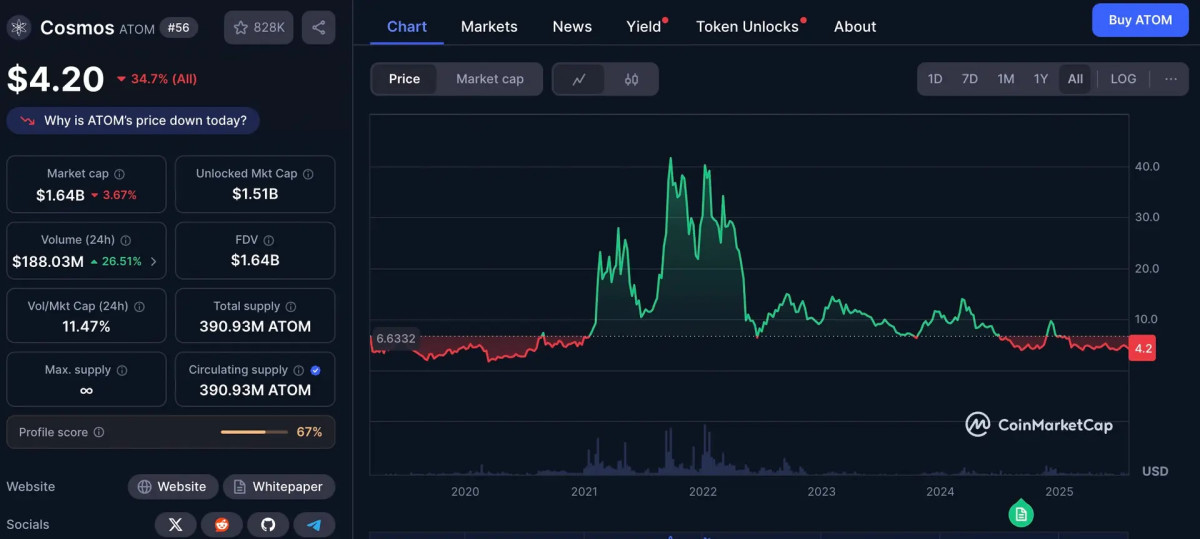
Notably, Cosmos’ token, ATOM, hasn’t returned to past highs, and the project’s leadership was marred by infighting between early co-founders. But under Interchain Labs’ stewardship, Mareneck says those issues are behind them. “We massively restructured the leadership team… a lot of people were let go… a lot of new people were brought in,” he said. “We’ve completely changed how we market Cosmos.”
That includes a new focus on practical tools like bridges, oracles, and developer-friendly SDKs. That means setting sights on potential competing services being offered by Chainlink or LayerZero and executing better.
Cosmos is also working on integrations with wallets like MetaMask and Phantom to improve accessibility. “The internet should not feel like it's isolated internets,” Mareneck said. “There shouldn't be an Ethereum ecosystem and a Solana ecosystem and a Cosmos ecosystem… these are all just chains… that can be connected.”
Looking ahead, he sees a coming consolidation wave where usage will determine which chains survive. “Most things are going to continue suffering… until they run out of steam and die,” Mareneck predicted. “And a few things are going to gain massive levels of adoption.”
Given the changes, he and the rest of those in the Cosmos ecosystem, believe a flurry of activity can set Cosmos and the ATOM token that powers it on a new path.
“I see the usage. And the usage is real,” he said. “It’s more real than anywhere else I’ve seen among developers. And I think that’s going to carry us forward.”